














Comparison method
How to compare MGA darts betting sites
Compare darts sites using the same fixture, format and market. A match played in legs needs different reading from one decided in sets, and a player 180s total differs from a match total. Start with those details, then assess rule access, mobile navigation and account conditions.
The first useful search is for a specific event. Record the tournament, round, players and scheduled start. Darts coverage can vary between competitions and fixtures, so a prominent darts icon does not tell you whether the product includes the event or specialist market you want. Open the full event page before forming a shortlist.
The casino cards above are broader casino profiles. They do not confirm darts coverage or a sports offer at each operator. Treat the sports product as a separate check: establish whether the intended event is present, whether the account is available for your location and which product terms apply before using a casino profile as a starting point.
Start with five details
- The exact players, competition and round.
- Whether the match is decided by legs or sets.
- The named market and its player, leg, set or match scope.
- The displayed line and price at the time of comparison.
- A retrievable sport rule and clear account conditions.
The MGA betting sites guide covers the shared sportsbook framework. This page narrows that framework to darts, where a short label can conceal an important distinction between winning a leg, winning a set and winning the match. Keep those comparisons in separate rows rather than combining them into one general market score.
A short, dated shortlist is enough. If an event is not yet listed, record availability as unresolved and check again when the market opens. Do not infer permanent coverage from one fixture, or permanent absence from one quiet session. Compare what is actually available for the event you are considering.
Practical guidance
Darts legs and sets: read the format first
A leg is an individual game; a set groups legs within the match format. Read the stated winning target and market unit before comparing a handicap, total or correct score. A set score does not tell you the total number of legs, and a leg handicap cannot be compared directly with a set handicap.
In a hypothetical first-to-seven-legs match, a final score of 7–4 contains eleven completed legs. That tells you both the winning margin in legs and the match length. In a sets-based match, the headline result might instead be 3–1 in sets, with a separate leg score inside each set. The headline alone does not reconstruct the leg count.
| Market scope | Information to capture | Common comparison mistake |
|---|---|---|
| Match winner | Players and complete match format | Treating a current set leader as the match result |
| Leg handicap | Player, signed line and legs as the unit | Comparing it with a set handicap |
| Set handicap | Player, signed line and sets as the unit | Using the aggregate leg score to assess it |
| Total legs | Match or named set, plus the line | Assuming every set lasts the same number of legs |
| Correct score | Score order and whether it refers to legs or sets | Reading the first number as the selected player without checking |
“Best of” describes a maximum under the stated format; “first to” identifies a winning target. Check any deciding-set or deciding-leg conditions rather than assuming the ordinary pattern answers every situation. A format change can affect totals and handicaps even when the two players remain the same.

Format checklist
- Record legs or sets explicitly beside each market.
- Check the winning target and any deciding-stage exception.
- Confirm which player appears first in a correct-score selection.
- Recheck the format if the fixture or round changes.
The guide to reading account terms explains how to distinguish a general condition from a product-specific rule. For darts, retain the event format alongside the market rule so that the number on a handicap or total has a clear meaning.
Practical guidance
Match winner, handicaps and total legs
Darts winner, handicap and total markets measure different parts of a result. Match winner concerns who wins; a handicap applies a stated adjustment; a total concerns the number of legs or sets covered. Compare the same unit, line and scope before using price as the deciding detail.
Return to the hypothetical 7–4 result in a first-to-seven-legs match. The winning margin is three legs. On an ordinary two-way leg handicap of minus 2.5, the winner’s adjusted seven becomes 4.5 against four. At minus 3.5, it becomes 3.5 against four. The result is unchanged, but the two handicap lines describe different selections.
The same match contains eleven legs. That is above a total line of 10.5 and below a line of 11.5. If the line is an integer, find the rule for equality. Do not transfer the half-leg example to an integer line without checking whether the market allows a push, another outcome or different settlement treatment.
Like-for-like market check
- Use the same event and match format on both sites.
- Copy the signed handicap rather than only its numerical size.
- Distinguish match totals from totals within a named set.
- Check correct-score ordering and the available outcome list.
- Read tie or equality treatment for the exact market type.
A correct-score selection is more specific than a match-winner selection. It depends on the stated final score in the named unit, not simply the selected player winning. A market for winning the next leg is narrower again. Keep these products separate when assessing whether a site has the market depth you need.
The tennis betting guide also separates match outcomes from smaller scoring units. The comparison habit is useful across sports, but the actual rules are not interchangeable. Use darts-specific format and settlement wording for every darts selection on your shortlist.
Betting markets
Comparing 180s and highest-checkout markets
For 180s and checkout markets, establish who is being measured and over which part of the event. A player total, combined match total and most-180s result are different propositions. Highest checkout concerns a finishing score, so it needs separate reading from a scoring-visit total or a 180 count.
A 180 is a scoring visit of three treble twenties. A player 180s total counts that player’s qualifying visits within the market scope, while a match total combines the relevant players’ counts. In a hypothetical match with counts of four and three, the combined figure is seven. The individual figures remain four and three.
| Market | Scope to record | Rule question |
|---|---|---|
| Player 180s total | Named player, line and match or set | Which part of the match contributes? |
| Match 180s total | Combined count and line | Does a shortened match change settlement? |
| Most 180s | Outcome choices and match scope | How is an equal count handled? |
| Highest checkout | Player or match, and stated period | What happens if the highest qualifying figures tie? |
| Checkout threshold | Over, under or exact condition | Does the wording concern one player or either player? |
Do not confuse a high scoring visit with a checkout. The checkout is the visit that finishes a leg under its rules; a 180 visit is not automatically a finishing visit. Read whether a checkout market concerns the highest of the match, a named player’s highest or a threshold in a particular leg or set.
Scoring-market checklist
- Read the complete player or match label.
- Record the count or threshold and the covered period.
- Check equal-result and interrupted-match treatment.
- Find the nominated result source and correction policy.
A longer format can provide more opportunities for recorded events, but that observation is not a forecast for any player. Use the format to understand the market scope. Do not treat a familiar name, a previous match statistic or an attractive special-market heading as evidence that a particular count will occur.
Payments
Changed formats, withdrawals and settlement rules
Read darts settlement rules before comparing products that depend on the match being completed as listed. A withdrawal, postponement or format change can raise different questions for a match winner, total, handicap or scoring statistic. Check the exact market and product conditions rather than assuming one rule resolves every selection.
A match may be displayed with a scheduled start and a stated format before play. Record both when reviewing the market. If the schedule changes, check the operator’s postponement window and any event-identity conditions. If the format changes, find the provision for markets whose original line depended on the number of legs or sets.
An unfinished match and an already completed leg are different scopes. That does not establish how a particular bookmaker settles either one; it identifies the question you need answered. Ask whether the selected market had been determined, what completion condition applies and whether a special product has its own exception.
Rules to locate before a decision
- The event’s start and postponement conditions.
- The policy for a player withdrawing or a match ending early.
- Treatment of a change to the advertised legs or sets format.
- Conditions for markets already determined before an interruption.
- The result source, correction process and account query route.
The account security checks covers keeping account records without exposing sensitive details. Save the event, market, line, accepted price and time in a secure place. A screenshot of an earlier market list can provide context, but the accepted selection record is the better starting point for a question about what was actually submitted.
If you contact support, ask a narrow question using the full market name and a hypothetical situation. For example, ask how a named set-total market is treated when the advertised format changes. A generic assurance that “darts bets follow our rules” does not answer the specific comparison question.
Practical guidance
Live darts: leg context and selection status
For live darts, compare how clearly the interface shows the set, leg, score and status of the selection. A stream, scoreboard and market feed can update at different moments. Confirm the named leg or set in the slip, then use account history to establish whether a submitted selection was accepted.
A next-leg market is especially dependent on context. Check whether “next” refers to the leg currently available in the product and whether the full event heading includes a set number. When a set finishes, the leg numbering may restart within the following set. A bare label such as “leg two” needs that surrounding information.
If the interface shows a throw indicator, understand which player it identifies and how it relates to the displayed leg. Treat it as part of the product’s information display, not proof that your screen is synchronised with play. A television stream or internet video can have its own delay.
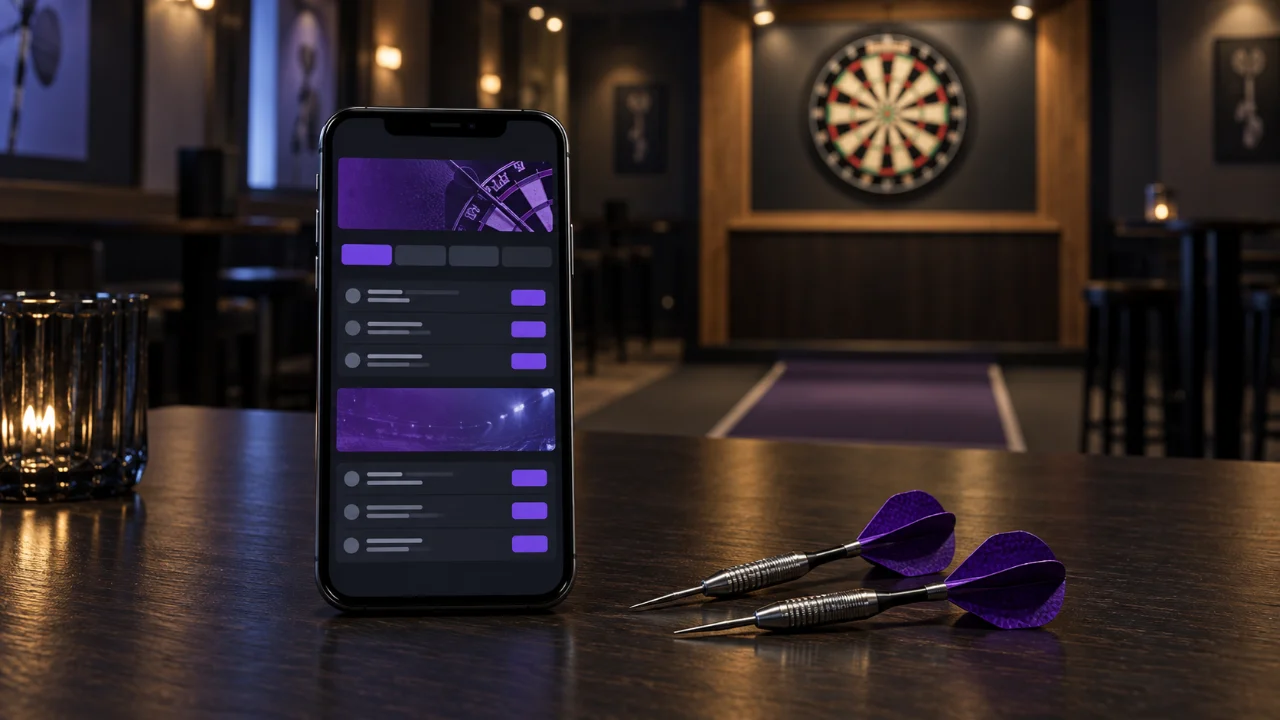
Live darts usability checklist
- The set and leg context remain visible when scrolling.
- Suspended markets have a clear status.
- The slip retains the complete selected market and player.
- Price-change settings are visible before use.
- Pending, accepted and rejected submissions are distinguishable.
- The account history keeps a retrievable selection record.
If a request remains pending, wait for a clear result before submitting again. Repeated taps can create confusion about how many selections were requested. Check the account record after a connection interruption rather than relying on whether a button still looks highlighted.
Use the betting apps and mobile sites comparison to compare navigation on the same device. For darts, the useful test is moving from an event to a named leg market, opening its rule and returning with the event context intact. You can assess that journey without placing a bet.
Betting markets
Darts accumulators, specials and combinations
A darts accumulator combines selections across events, while a same-match special or builder may combine connected outcomes inside one fixture. Read the product identity and void-component rules before comparing them. A selection available as a single is not automatically available in every combination or at a multiplied single price.
The accumulator betting guide provides the wider framework for multiple selections. In darts, record each fixture’s format and scheduled time separately. Several matches in one tournament session can appear close together, which makes it easy to overlook a different round, player pairing or market scope when building a list.
A match winner combined with most 180s describes two outcomes from the same fixture. The product may restrict such combinations or offer them through a separately priced special. Read the exact outcome requirements: winning the match alone does not satisfy a product that also requires a scoring-market result.
Combination checklist
- Identify singles, accumulators and same-match products separately.
- Read every component, including any tie-sensitive scoring market.
- Check whether connected outcomes can be combined.
- Review the final combined price and complete selection list.
- Find the product’s treatment of a void or unfinished component.
- Check any promotion conditions for the chosen combination type.
Suppose a hypothetical special requires a player to win and record the most 180s. A match victory with an equal 180 count leaves a rule question about the second component. It is not enough to see that the selected player won. Find the special’s wording for equal counts before deciding what the product requires.
The bonus terms guide is useful when an offer adds qualifying odds or combination conditions. Keep those conditions separate from the sports settlement rule. Meeting a promotion’s eligibility requirement and satisfying the selected sporting outcomes are different parts of the transaction.
More components mean more details to review. Keep a comparison centred on the market you intended to assess rather than expanding it just because a builder suggests additional outcomes. A product with fewer clear options can be easier to evaluate than a crowded list of unfamiliar specials.
Payments
Mobile, payment and account checks for darts
Evaluate the darts interface and the account behind it as separate parts of the shortlist. The mobile view should preserve player names, leg or set scope and selection details. Payment and verification information should be accessible independently, with clear conditions for the method and account you intend to use.
| Area | Useful check | Record separately |
|---|---|---|
| Event navigation | Players, round and start time stay clear | Availability for the intended fixture |
| Market labels | Player, leg, set and line remain readable | Any abbreviated label that needs expansion |
| Payments | Deposit and withdrawal methods are explained | Limits, fees and method-specific conditions |
| Verification | Requirements and secure upload route are described | When additional checks can be requested |
| Account controls | Limits, history and sign-out are accessible | Any device-specific navigation problem |
Use the account verification checklist to prepare your account questions. Find which documents may be requested and where they should be submitted securely. A quick registration form does not answer the later verification question. Avoid uploading personal information merely to compare a navigation feature.
The payout comparison guide helps separate processing stages from payment-provider transfer times. For a darts account, confirm whether the stated methods and conditions apply to the sports product. A logo in a footer does not by itself establish that the same method supports both deposits and withdrawals.
Compare the same event on an app and a mobile browser where both are available. Look for truncated player names, sticky panels covering a market heading and help links that discard the fixture context. A screen can look polished while still making a specific leg or set selection hard to review.
Final account checks
- Account access and terms apply to your location.
- The intended payment route supports the required transaction.
- Verification and withdrawal conditions are understood.
- Limits and account history are easy to reach.
- Any sports promotion is assessed on its own written conditions.
Betting markets
Build a darts shortlist around your usual markets
The strongest darts shortlist is the one that fits your actual comparison task. Match-winner readers need clear fixtures and format rules; scoring-market readers need precise 180 and checkout scope; live readers need visible leg context and status messages. Resolve missing essentials before weighing optional features or promotions.
For occasional tournament browsing, start with the event list and match-winner market. Confirm the players and round, then find the rule without opening unrelated help categories. For regular scoring-market comparisons, spend more time on player-versus-match scope, equal-count treatment and result corrections. For live browsing, follow one event through the set and leg navigation.
Benefits and limits of a darts-focused comparison
Advantages
- Legs, sets and scoring statistics stay in separate comparison fields.
- A short list makes unresolved rule questions easier to spot.
- The mobile test follows the journey you actually expect to use.
Limitations
- Coverage can change by event, round and scheduled session.
- Clear information cannot remove uncertainty from a sporting result.
- Saved comparisons need refreshing when formats or product conditions change.
Your final darts checklist
- The fixture and current format are confirmed.
- Each market has a clear player, leg, set or match scope.
- Handicaps, totals and correct scores use the intended unit.
- 180 and checkout tie questions have written answers.
- Live status and accepted-selection records are readable.
- Payment, verification and account controls fit your needs.
- Unresolved questions are settled before proceeding.
Return to the MGA betting sites guide for the wider framework, and keep the MGA casino profiles separate from sport-specific availability checks. A dated comparison note should contain only the event, market and conditions you need to revisit. It should not rely on an old homepage offer or an assumption carried over from another sport.
Completing the checklist does not require making a selection. If a market remains unclear, leave that candidate off the shortlist. Set a budget you can afford to lose, keep account limits accessible and avoid increasing a stake to recover a previous loss. Betting is for adults aged 18 and over.